
A picture can paint a thousand words. And in the emerging science of text-to-image generative artificial intelligence, the Diverse Corn Belt Project’s (DCB) Reimagining Agricultural Diversity (RAD) Teams are using this technology to turn rural landscape words and concepts into images that foster understanding and depth of discussion.
The process of creating visuals that depict diversity concepts like alternative rotation crops, grazed livestock, agroforestry, and fruit and vegetable production began with intensive focus group discussions in 2023. But the release of text-to-image generative AI offered an opportunity to not only speed up the process of imagery creation, but to do it in a way that more accurately and consistently represents farmer perspectives.
“We could have generated the images many different ways,” says Aaron Thompson, Ph.D., professor at Purdue University and a RAD Team member. “But we wanted to make sure that we were representing landscapes in a way that wasn’t just the result of a bunch of experts sitting around somewhere developing it. We wanted to generate them based off of how producers truly view them and describe those things.”
Digging in on AI
The potential of artificial intelligence is expansive, a reality that is both exhilarating and exhausting. Harnessing its power for agriculture, and ultimately for the RAD visioning project, was going to take a lot of front-end work to understand how to use it to get the desired results.
Enter Ishraq Awashra in August 2023, a Purdue University doctoral candidate with a passion for landscape design who had recently completed an interdisciplinary master’s degree studying the evolution of terracing structures in the Mediterranean.
“When I reached out to Dr. Thompson at Purdue, I told him that I’m interested in design and agriculture, and he said, ‘Well I have a project for you, and I have funding!’” Awashra says. “Ultimately, I came to Purdue because I wanted to understand how we can bring agriculture and design together so that we can understand the past and inform the future of rural communities in the Corn Belt.”
With no real guidance on how generative AI could be used in landscape design, Awashra spent part of her first semester at Purdue on an independent study program diving deep into generative AI for turning text into images.
“I wanted to understand how we can bring agriculture and design together so that we can understand the past and inform the future of rural communities in the Corn Belt.”
According to Thompson, the idea of text-to-image AI wasn’t on many people’s radars.
“This is reshaping our industry right now, but back then with Ishraq’s planned project, we were the first ones really out there with community partners using this technology to visualize landscapes,” Thompson says.
After extensive testing of generative AI tools, Awashra settled on Midjourney, then figured out how to use it.
“I was sometimes spending 30 hours a week researching and experimenting,” she recalls. “As simple as it looks, it’s very hard to understand how to engage with the software to get the result you are looking for.”
Eventually, Awashra and an undergraduate student headed for the Purdue Memorial Union, a student gathering place, to test what she’d discovered.
“We called people over and asked them to imagine and describe a landscape,” Awashra says. “They would describe something, and we would enter the appropriate prompts and show it to them to see if it matched what they were thinking.”
This “pilot” approach received positive feedback from participants, which begged the question, could learnings from the students’ experience be used to support the RAD Teams’ work to convert the farmer focus group data into AI-generated rural landscapes?
Turning Data into Images
Of critical importance was the existence of strong base data. The RAD Teams focus groups provided a wealth of excellent background information to feed the AI program. The focus group conversations were complex, from changing policies to weighing up what types of cropping systems to advance as potential solutions.
“Early in this project before sharing images, we had focus groups where we just brought people in and threw five or six cropping systems at them,” Thompson explains. “Could we bring livestock back to the Midwest in a large-scale way? What about agroforestry? Are there any avenues that are actually economically viable?”
With some of the lesser understood diversity discussions, people would talk in generalizations but not get down to specifics that would lead to making progress.
“And so, the basis for Ishraq’s work was really this idea of, can we bring visuals into these meetings to help us generate a more specific conversation about what people do and do not want to see happening in the landscape?” Thompson says.
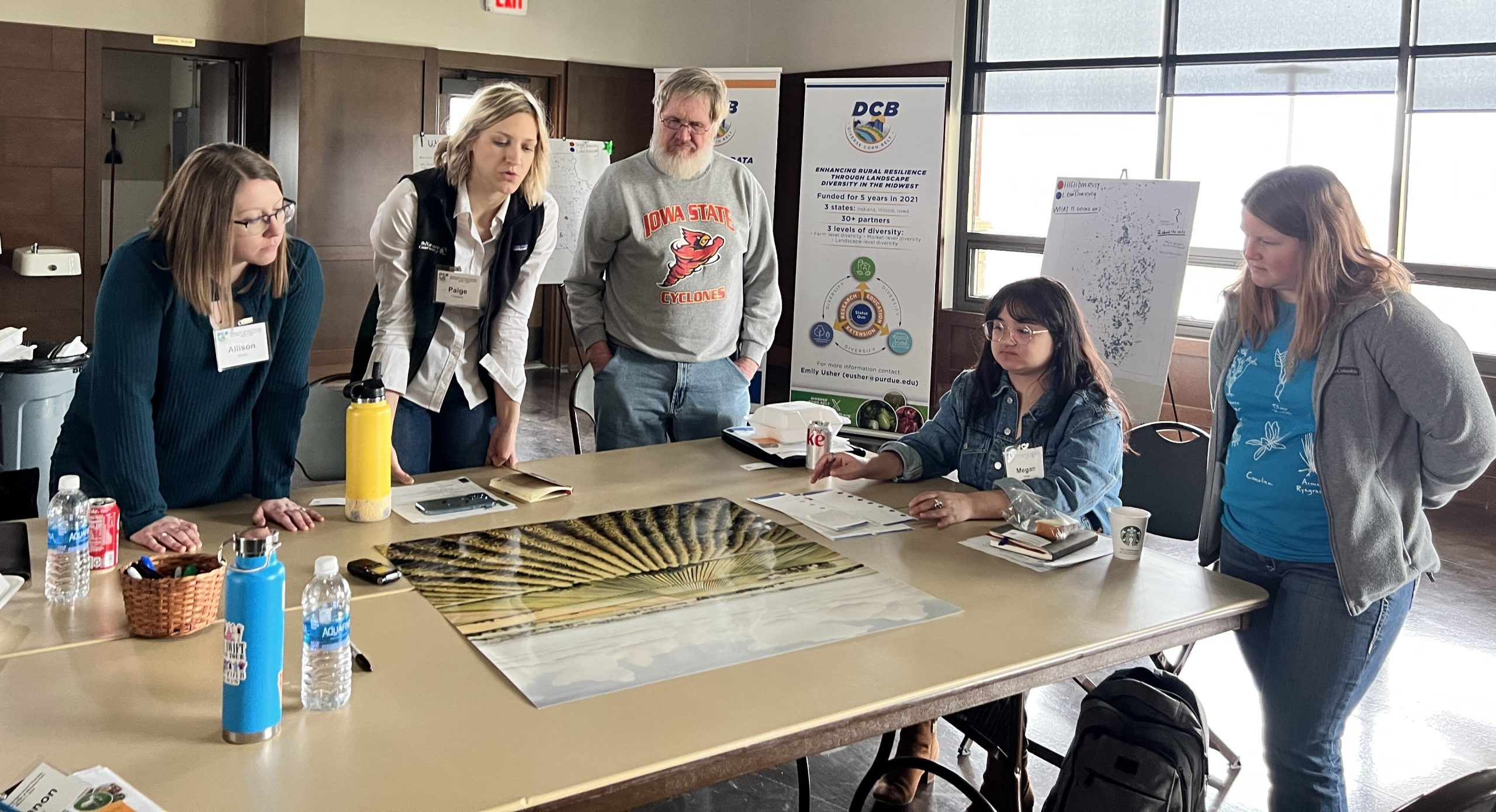
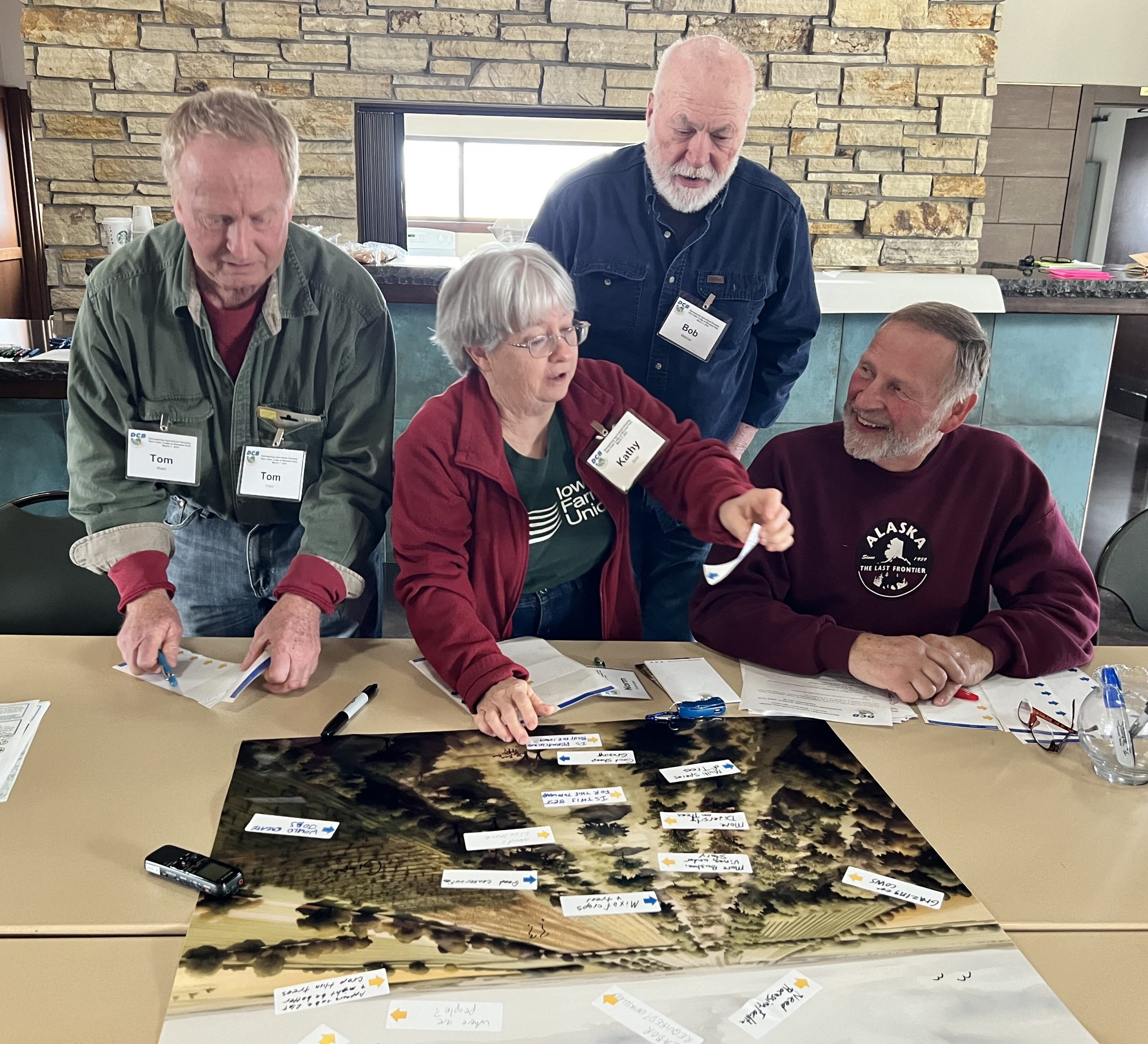
Participants at the second Iowa RAD Meeting suggest changes and additions needed to an AI landscape image of the current Corn Belt landscape.
During the summer of 2024, RAD Teams put the AI-generated rural landscape images to the test, printing posters of the images and allowing farmers and trusted partners to view, critique, and discuss them.
“We asked them to give us the details of how they would actually adapt this to make the system work where they live,” says Thompson. “And we got detailed, specific conversations about each one of those systems, about the things they did and didn’t like.”
Some of the participants’ reactions were expected. For example, taking an entire landscape and turning it over to agroforestry made every producer in the room turn and say, “I can’t make a living that way,” or “I’ll be bankrupt before the 15 years it will take until I get to something that’s going to produce.”
But there were also some unexpected results. Participants really focused on missing activity and infrastructure such as people existing within the landscape, homes where employees would live, nearby city centers, and agriculture infrastructure such as elevators and ag retail operations.
Armed with all the feedback, RAD Teams will continue to revise the images. Thompson says one great benefit of using AI is that it acts as a third-party arbiter of how the words and terminology of the farmers is interpreted in the image.
In the future, AI could simply become a component of the focus group, delivering changes to rural landscape images as they are suggested.
“You can have a technician on the side, basically creating the graphics as we discuss them,” says Thompson. “I think that we are very, very close to this being a reality.”
This article was written by veteran agriculture journalist Paul Schrimpf, president of Alameda Communications, and edited by DCB Communications Team Member Elise Koning, project director for Conservation Technology Information Center.