
For Diverse Corn Belt participants and partners, the process of futuring has provided a fascinating and instructive picture of what’s possible in the rural landscape.
Futuring aims to discover many possible outcomes for a particular business or market based on the impacts of emerging and evolving trends. Drivers of these events and outcomes include politics and regulation, finance, technology, society at large, and the environment.
Beginning in 2023 just prior to the initial meeting of the RAD Team, DCB worked through a futuring regimen to develop and illuminate these diversification visions. Team member Kristin Floress, Research Social Scientist with the Northern Research Station of the USDA Forest Service in Illinois, says futuring pushes the limits of what is possible, or even probable, beyond current science.
“You can think about a worst-case scenario—here’s what those scenarios might look like—but you can also think about what could actually improve or open up opportunities for rural communities,” says Floress. “What would these different alternatives provide in terms of a brighter future?”
One aspect of the futuring process was horizon scanning. The goal was to find ideas and trends outside the scope of scientific literature that apply to agriculture and that could potentially impact the future of farming and rural landscapes.
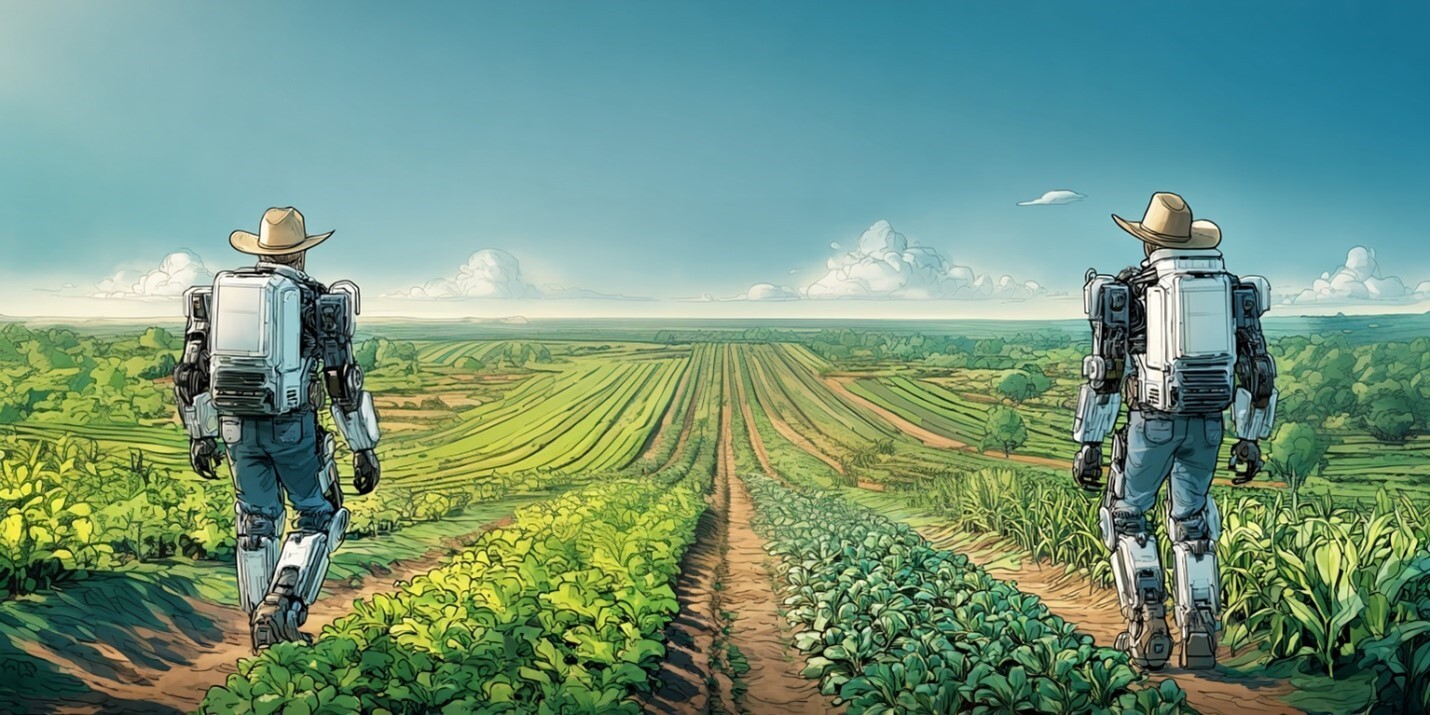
Text-to-image generative AI was used to convert concepts that emerged from the horizon scan into rural landscape visualizations. Here, exoskeletons provide extra support for farmers and reduce strain on their bodies.
To accomplish this, team members used collection and tagging tools such as Google News alerts to skim off relevant stories and information. For two months, RAD Team members monitored the Internet and gathered everything they could find. Every related trend or topic, called a scan hit, was categorized and placed in a central database for analysis. In addition to considering the weight of the expected impact of the concepts, each was judged by its likely timeline of impact, whether near (next season), medium (5 to 8 years), or long-term (20-30 years).
It turned out there was a lot of “stuff” out there from a wide range of sources that, while not recognized as scientifically “credible” from a researcher’s standpoint on their own, provided a truck load of fodder for discussion and consideration.
“I went to Reddit a bunch of times in the farming sub-Reddit and read a lot of blogs,” Floress recalls. “We got hits from unexpected sources, such as architectural journals. There’s a lot of interesting and honestly weird things happening out there, in science as well as out in more creative or imaginative fields, that could potentially represent a piece of a possible future.”
The team gathered 186 scan hits that they categorized and whittled down to a manageable 35 concepts. The concepts were discussed and evaluated by agricultural diversification stakeholders from across the value chain, who selected 18 key issues.
The RAD Team’s parallel project on rural landscape visualization informed its approach to whittling down and finalizing the issues, says Aaron Thompson, Purdue University professor and member of the RAD Team. Stakeholders providing input at RAD Team Meetings influenced the prioritization process for the horizon scan.
“The vast majority of the people involved in the evaluation process were at the initial RAD Team meeting, and so we were hearing from farmers the types of things that they thought were likely to affect them,” Thompson explained. “That impacted our selection of the horizon scan themes that carried forward into those scenarios.”

Each concept was built out with visuals and descriptions to make them easy to understand and act upon. The RAD Teams developed paragraphs explaining each concept and what the future of agriculture might look like as a result.
Concepts that were discerned out of the process featured both the broad and the highly specific. Not surprisingly, climate change – among the broadest and most unwieldy concepts – emerged at the top of the ranking.
The team noted that a frequent theme “was the threat posed by future increases in the frequency and severity of extreme weather events, such as drought, storms, flooding, and wildfire.” The impacts of these events on agriculture “include decreased crop yields, heat stress on farm animals, soil erosion from heavy rainfalls, and effects on rural communities and agricultural workers.”
Other concepts were laser-focused. Agrivoltaics, which came in second among the concepts, combines energy-generating technology from solar panels with farming and ranching operations such as livestock grazing, vegetable production, and honey production. Most energy installations today are separate from the farm operation, but there is also a movement to co-locate energy generation within farms.
“It ties into many other issues, like land affordability,” Floress says. “It could change the entire composition of ownership of agriculture lands in the Midwest based on what the land is used for.”
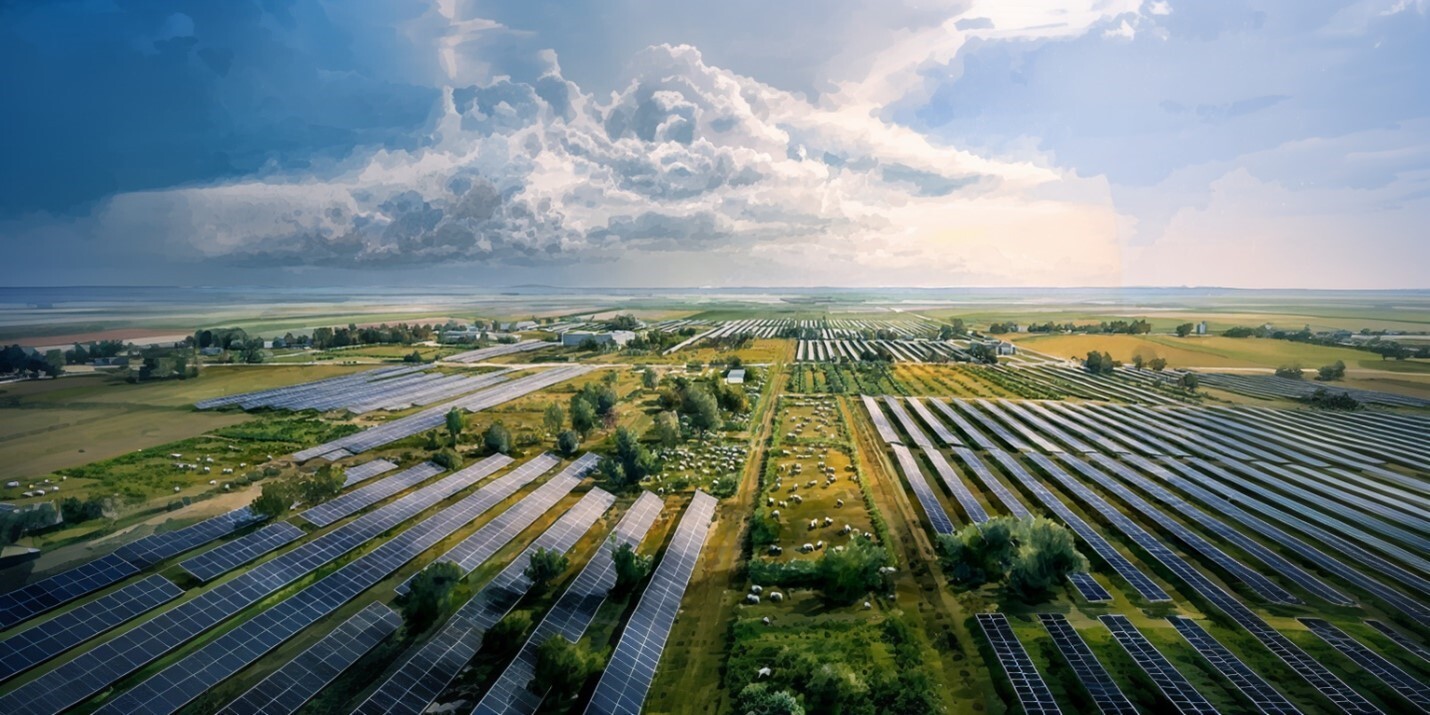
Text-to-image generative AI was used to convert concepts that emerged from the horizon scan into rural landscape visualizations. Here, solar panels and farming work together in agrivoltaics.
Another high-ranking concept was also not a big surprise: artificial intelligence. Agriculture companies across the spectrum, from input manufacturing to drones and precision ag equipment, are looking to integrate AI in ways that improve functionality and ease of use of their products, which will almost certainly cause disruption in the crop value chain.
“There are a lot of individuals and organizations with high hopes about implementing AI and machine learning to make a positive impact, from mitigating labor shortages to reducing data recording errors to helping manage the books,” says Floress.
“There’s the potential for AI to transform farming in so many ways,” she continues, “possibly even toward a brighter future. For example, with efficiency improvements through AI, people may be able to have more time to spend with their children or create art. This could have a cascading effect down through society that creates an appreciation for civic life.”
One outside-the-box technology that made the cut was the utilization of robotic exoskeletons. These machines have been used for medical purposes for several years, such as assisting disabled individuals or aiding rehabilitation following injury. For example, these technologies are being applied to the farm through the National AgrAbility Project.
But exoskeletons can also be employed to augment the abilities of able-bodied people, allowing them to accomplish tasks that would be difficult or impossible without augmentation.
“Farmers can use them to reduce strain and just get extra support,” says Floress. “It’s giving you a little extra stability and support when you’re lifting. We accept that farming is an occupation that takes a physical toll and someday will result in pain, surgery, or joint replacement in advanced age. What if we could reduce or eliminate a lot of that wear and tear and improve quality of life?”
The RAD Team is in the final stages of editing a paper on the horizon scan results with high hopes for its publication sometime later in 2026.
Find out more about the work of the RAD Team and how it all began with focus groups, as well as the text-to-image generative images work of the RAD Team.
This article was written by veteran agriculture journalist Paul Schrimpf, president of Alameda Communications, and edited by DCB Communications Team Member Elise Koning, project director for Conservation Technology Information Center.